At a glance
Bring the product range, brand guidelines, available site information and opening plans. Identify what is fixed and what the designer can change.
Explain what the project needs to change.
A retail store design brief can begin with a straightforward description of the business situation. You may be opening your first physical space, entering the U.S., refreshing an established identity or adapting a concept for another location. Explain what has prompted the project and what the new store should improve.
Be specific about the customer experience you want to create. Perhaps people need to try a product before choosing it. Perhaps the store should make a broad assortment easier to understand. Perhaps the brand needs its first coherent physical identity. Each starting point suggests different work.
If the project has several ambitions, put them in order. The team needs to know which one should guide a difficult choice when the site, timing or available resources make everything impossible to achieve at once.
Bring the brand as it exists today.
Share the identity guidelines, packaging, campaign imagery and any existing store material that accurately represent the brand. Bring examples of the product itself where practical. Explain which parts are established and which are open to development.
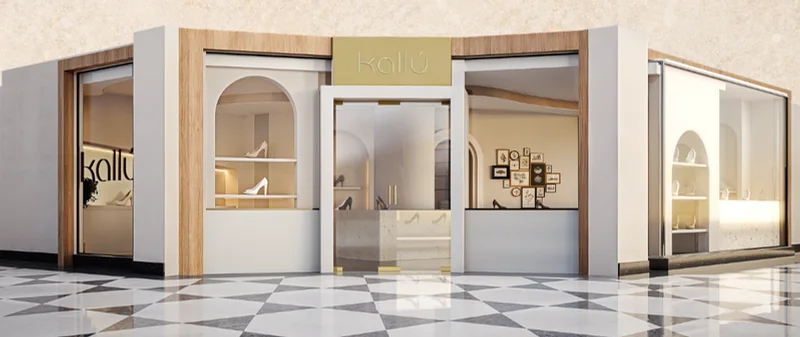
This is especially useful when brand identity creation and store design are happening together. Retail by PopUp’s Kallu work combines identity development with planning for a first U.S. flagship at The Palazzo Shops in Las Vegas. The project is in development, with opening planned for Q4 2026. The proposed interior uses arches and curved fixtures drawn from the shape of a shoe sole, alongside seating and service areas.
Describe what attracts you to reference spaces. A photograph labeled inspiring leaves the designer to guess whether you mean its materials, intimacy, layout or display. A sentence pointing to the relevant detail makes the reference much more useful.
Share the working facts, including the incomplete ones.
If there is a site, bring the information available about it: the address, plans, photographs and the property questions still being resolved. Mark whether dimensions and existing conditions have been verified. If there is no site yet, say what kind of search is underway and which criteria are fixed.
Bring an assortment outline, the intended service routine and your assumptions about stock. Include what you know about staffing, delivery and ongoing management. The designer needs to understand the space as a working store as well as a visual expression of the brand.
Share the target opening window and the resources you have allocated. Distinguish a desired date from a date that is already committed, and identify the decisions that still affect it. Honest uncertainty gives the project team something to plan around.
Clarify where you need help.
A project may need identity creation, spatial design, visualization, fabrication coordination, installation support or a combination of these. It may already have an architect or another design partner. Name those relationships and the work you expect each team to own.
Ask the prospective partner to explain its proposed deliverables and review process in concrete terms. What will the team receive at each stage? What decisions will those materials support? Who will turn the approved concept into information needed for delivery?
- Brand: what exists and what needs to be created or renewed.
- Space: the site information, assortment and operating needs.
- People: decision-makers, existing partners and the future store team.
- Delivery: proposed scope, opening window and unresolved dependencies.
Agree what the design proposal needs to cover.
The first meeting does not need to settle the design. It should make the next piece of work clear: an identity discussion, a site review, an assortment exercise or a defined design proposal. Agree who will supply the missing information and what the team can usefully do with it.
If the assortment or site is still undecided, ask how that affects the design scope and which work can usefully start now.
How we can help